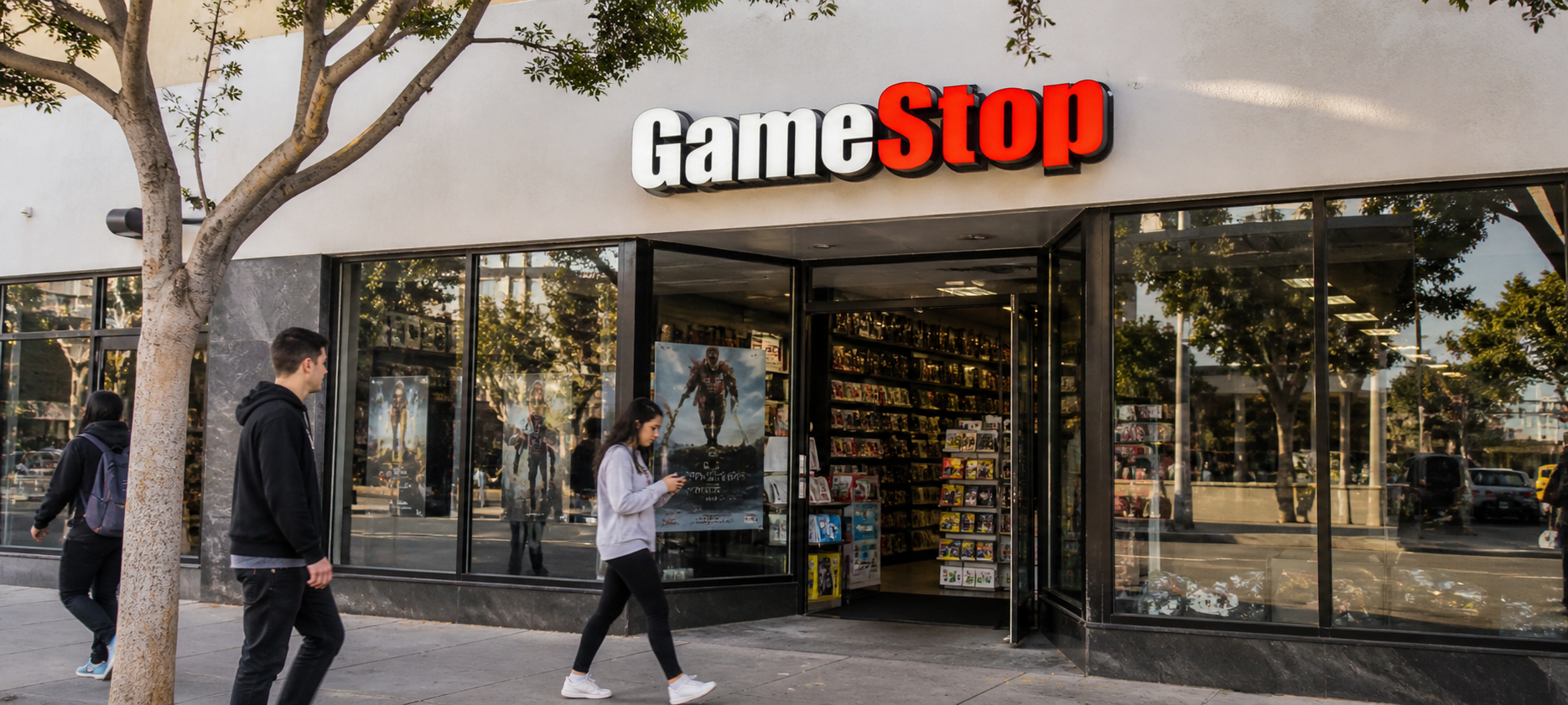
GameStop (GME) stock is gaining on Monday after the gaming merchandise retailer’s surprise release of its preliminary second-quarter results.
Despite the positive price action, core challenges persist – net sales are projected to decline year-on-year to between $780 million and $800 million, down sharply from $972 million a year ago.
At the time of writing, GameStop shares are down over 30% versus their year-to-date high.
What’s driving GameStop stock higher today?
What energized buyers in the preliminary report was GameStop’s improving profitability.
The company expects Q2 net income to reach $290 million to $310 million, roughly doubling the $168.6 million recorded in the prior-year period, mostly because of financial restructuring rather than retail expansion.
GameStop converted derivative holdings into an equity stake of 43.4 million eBay shares valued at $4.947 billion, generating about $238 million in net gains.
For GME shares, these gains highlight management’s ability to leverage its massive balance sheet to engineer net profits, partially offsetting a $75 million loss on digital asset holdings and providing a buffer while physical store revenue shrinks.
Why GME shares remain unattractive to own
While the profit expansion sure looks enticing on paper, purchasing GameStop stock based on the preliminary numbers remains a high-risk proposition.
The report makes clear that GME is increasingly operating like an investment vehicle rather than a traditional retailer.
Cash, cash equivalents, and marketable securities fell to roughly $5.06 billion from $8.694 billion a year ago following the equity conversion.
Value-oriented investors may appreciate the price-to-earnings (P/E) ratio and asset backing – but retail fundamentals remain unsupportive.
Unless an investor actively seeks exposure to a holding-company strategy powered by corporate treasury plays, adding exposure ahead of complete Q2 results on September 8 appears premature.
How to play GameStop ahead of full Q2 earnings
Ultimately, the preliminary update alters GameStop’s corporate identity more than it cures its fundamental retail decline.
The investment thesis has officially evolved from a simple turnaround narrative into a hybrid balance-sheet play. Management’s active monetization of strategic equities demonstrates financial agility, giving the company an extensive runway to pivot.
However, long-term share performance can’t rely indefinitely on non-operating investment gains.
Until GME stock presents a clear, scalable roadmap to reignite top-line commercial growth, the broader thesis stays neutral: the firm offers some downside protection through liquid assets – but lacks sustainable operational catalysts.
What is the consensus rating on GME?
Another major red flag in owning GameStop at the current price is the absence of Wall Street coverage.
As of writing, the gaming merchandise retailer receives coverage from just one analyst, and even they rate it at Hold only, with a price objective of $13.5 indicating potential for significant further declines over the next 12 months.
The post GameStop preliminary Q2 report: does it change the investment thesis? appeared first on Invezz