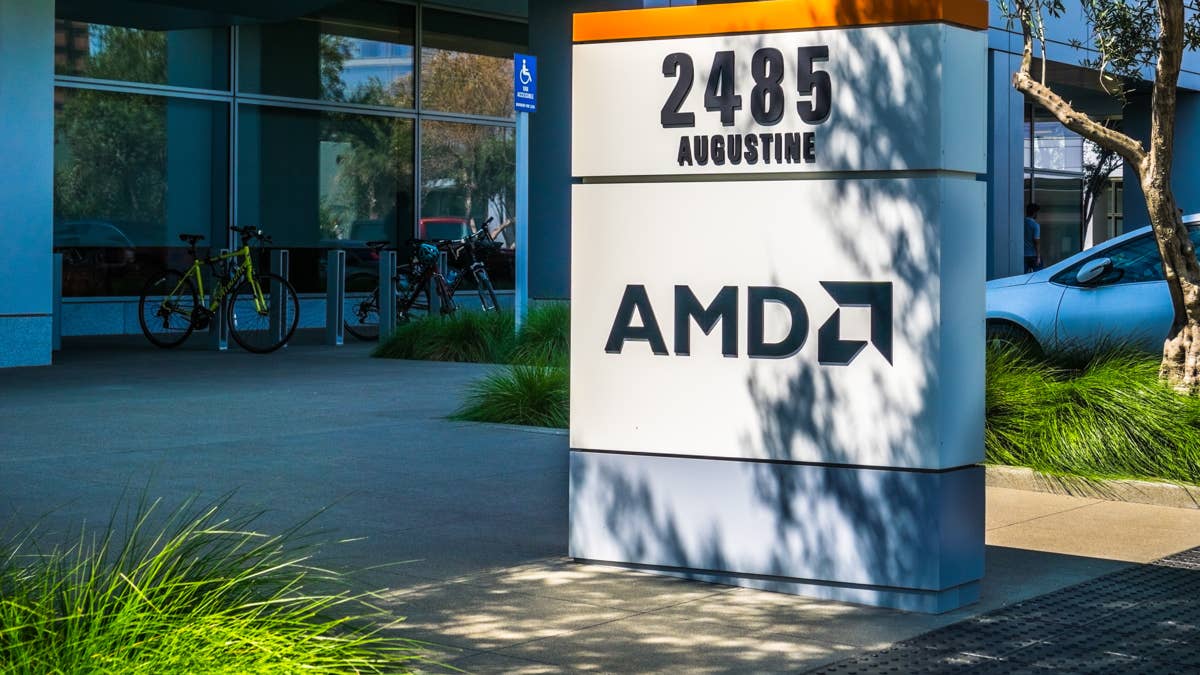
Advanced Micro Devices (AMD) just reported the strongest quarter in its 56-year history, and shareholders responded by selling.
The chipmaker posted record revenue, more than doubled its data center sales, and raised its outlook above what Wall Street expected.
On paper, it was close to a perfect print, but the stock fell anyway. It droppedas much as 10% on Wednesday, Aug. 5.
The reason had almost nothing to do with the numbers AMD released. It came from a different earnings call happening the same night. That call was SpaceX‘s.
Why AMD stock dropped despite a record Q2 2026 earnings beat
AMD reported second-quarter revenue of $11.5 billion, up 50% from a year earlier, with adjusted earnings of $1.66 per share. Both figures beat expectations.
Data center revenue more than doubled to a record $6.72 billion, a 107% year-over-year jump driven by demand for its Instinct GPUs and EPYC server processors.
More AMD Coverage:
- Bank of America revamps AMD stock price target for 2026
- Goldman Sachs resets AMD stock price target for the rest of 2026
- Top analyst strongly resets AMD stock price target
AMD guided third-quarter revenue to about $13 billion, ahead of the roughly $12.5 billion analysts modeled.
That still fell short of the more aggressive numbers some investors had penciled in, which was closer to $14 billion.
When a stock climbs more than 100% into an earnings date, meeting expectations often is not enough.
Sundry Photography / Getty Images
How Elon Musk’s SpaceX announcement affected AMD
The bigger blow landed during SpaceX’s first earnings call as a public company, held the same evening.
Musk told analysts that SpaceX will build its AI infrastructure exclusively on Nvidia (NVDA), calling the Vera Rubin architecture the best available, The Motley Fool reported.
The comment carried weight because Musk had said in May that his companies would likely keep buying from both Nvidia and AMD. This was a public reversal.
It also arrived at the worst possible moment for AMD’s core sales pitch.
For the past year, AMD has worked to convince investors that major AI buyers view its chips as a real alternative to Nvidia.
A high-profile customer choosing Nvidia exclusively undercuts that argument in front of the whole market.
Nvidia stock rose about 4% on the news, while AMD dropped up to 10%.
SpaceX, the Starmind satellites, and AMD’s lost pipeline
SpaceX no longer just launches rockets. It runs AI infrastructure at scale, hosting workloads for outside customers and building its own orbital compute program.
Alongside the exclusivity comment, SpaceX and Nvidia announced a partnership to build the compute payload for Starmind AI1, Teslarati noted.
The Starmind AI1 is a satellite designed to run AI workloads directly in low Earth orbit.
Each Starmind satellite will carry Nvidia’s Rubin GPUs and Vera CPUs. SpaceX aims to begin deployments as early as 2027.
What AMD lost with the SpaceX decision:
- A customer scaling AI compute capacity aggressively through 2027
- A pipeline analysts estimate could eventually exceed $100 billion in chip demand
- A reference win that would have validated its MI450 chips against Nvidia
None of that revenue was ever booked, so the direct financial hit is unclear. AMD did not disclose any specific dollar impact.
The damage is to the growth narrative, not the current quarter.
How AMD’s business is now leaning on one division
The quarter also exposed a concentration issue.
AMD’s strength increasingly comes from a single source. Its data center division now accounts for roughly 58% of total revenue, while its client and gaming segments show flatter growth.
Related: Fresh lawsuit drops bombshell on Micron stock price
That makes the company more sensitive to large data center customer decisions, which is exactly the type of decision SpaceX just made.
Investors reward concentration when the biggest market is expanding. They punish it when a major buyer defects, which helps explain the speed of Aug. 5’s selloff.
Why Wall Street analysts stayed bullish on AMD stock
Several major firms raised their AMD price targets right after the report, according to Yahoo Finance.
Analyst price targets after AMD’s Q2 report
- Wells Fargo: raised to $700 from $615, Overweight
- Jefferies: raised to $650 from $640, Buy
- JPMorgan: raised to $550 from $385, Neutral
Citi kept AMD as a top Buy idea, and KeyBanc stayed Overweight.
AMD CEO Lisa Su brushed off the SpaceX decision in a CNBC interview, saying she has tremendous respect for Musk and expects the two companies to keep working together over the longer term.
Su also pointed to secured multiyear deployments with Meta, Microsoft, OpenAI, and Anthropic, customers that keep AMD firmly inside the hyperscaler buildout.
What AMD needs to prove before the stock recovers
The company guided data center revenue to more than double in 2027 and expects overall revenue growth above its 35% target.
Analysts still see AI GPU growth running well over 100%. Turning those targets into reported results is what needs to happen next.
What has to go right for AMD’s thesis to hold
- MI450 chips win a visible, named hyperscale customer to replace the SpaceX narrative.
- Data center revenue growth stays above 100% into 2027.
- Client and gaming stabilize so that growth is not resting entirely on one segment.
For long-term investors, the record quarter shows the AI demand is real, and AMD is capturing a large share of it.
The SpaceX loss is a setback to the story, not a change to the fundamentals reported this quarter.
For shorter-term traders, the risk is simpler. AMD trades at a steep valuation, and the stock has little room for error when a major customer walks away.
Wednesday, Aug. 5, showed how quickly that can trigger a sell-off.
The next real test comes when Nvidia reports and when AMD has to convert its 2027 guidance into booked data center revenue.
Related: Wells Fargo doubles down on AMD stock after Anthropic deal